

Emergency Local Plumbers in Youngstown, OH and nearby cities
Emergency Local Plumbers in Youngstown, OH and nearby cities
Water finds its way in through the smallest openings, and by the time you notice it inside your home, it has usually been working at your foundation for a while. Exterior waterproofing is a home maintenance task that is often pushed down the list until a wet basement or a cracked foundation wall forces action. At Mr. Rooter Plumbing, we've seen what happens when the early warning signs get ignored. We’re here to help you get ahead of it. Keep reading to learn what effective exterior waterproofing entails and where some homeowners fall short.
Interior waterproofing manages water after it enters your home. Exterior waterproofing stops it before it reaches your foundation walls. That distinction is important because interior systems, like sump pumps and interior drain tile, redirect water that has already penetrated your structure. At that point, the damage to your foundation, framing, and insulation may already be underway.
Exterior waterproofing focuses on the source. It seals the outside of your foundation wall, reroutes surface water, and intercepts groundwater before hydrostatic pressure builds against your basement. The pressure is what causes wall cracks, bowing, and water intrusion through mortar joints and floor seams. Interior systems still have their place, especially as a backup, but they're secondary.
The slope of the ground around your home controls where rainwater goes. Proper grading directs water away from your foundation at a drop of at least six inches over the first ten feet from your house. When the slope runs toward the house instead of away from it, water pools against the foundation and eventually saturates the soil.
Compacted soil and clay-heavy ground make this worse. These materials don't absorb water quickly, so runoff sits against your foundation wall longer and increases hydrostatic pressure. Adding topsoil to raise and regrade low spots is one of the most cost-effective waterproofing steps a homeowner can take.
Drainage swales, French drains, and catch basins can supplement proper grading in yards where water concentrates naturally. A plumber or waterproofing contractor can determine whether your yard needs engineered drainage or if regrading the soil around your foundation will fix the problem.
Gutters and downspouts are part of your waterproofing system, whether you think of them that way or not. A standard roof sheds thousands of gallons of water during a heavy rain, and your gutter system decides where all of it goes. Clogged gutters overflow along the roofline and drop water against your foundation. Downspouts that end too close to the house dump concentrated runoff at your foundation corners, which are already a vulnerable point.
Downspouts should discharge at least four feet from your foundation, which can be achieved with extensions or underground pipes that carry the water farther out. Clean gutters at least twice a year, more if you have heavy tree cover. Check your downspout connections for leaks and make sure splash blocks are positioned to direct water away rather than letting it pool.
These are simple maintenance steps, but skipping them sends large volumes of water to your foundation repeatedly. Over several seasons, the concentrated drainage can accelerate soil erosion and saturate the ground faster than it can drain.
Dampproofing is typically a spray-applied asphalt coating that resists moisture vapor but isn't designed to hold back liquid water under pressure. Many homes built before the 1980s have dampproofing rather than a true waterproof membrane. The coating eventually degrades and cracks as the foundation settles.
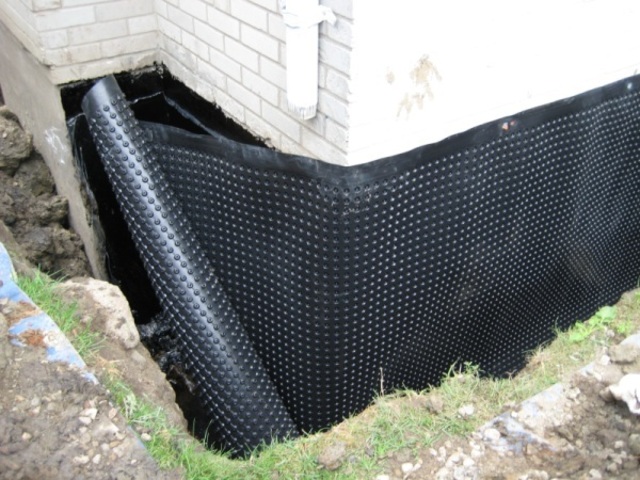
Waterproof membrane systems are more robust. Sheet-applied membranes, liquid-applied coatings, and drainage board composites all create barriers that withstand hydrostatic pressure. Sheet membranes, for example, are adhered to the foundation wall and overlap at seams to prevent water from penetrating at joints. Drainage board materials installed over the membrane create an air gap that channels water down to a footing drain so it doesn’t press against the wall.
This is work that requires excavating along the foundation perimeter. It's a serious project and not a DIY repair. A dependable plumber or waterproofing contractor will excavate, prepare the wall surface, apply the membrane system, install drainage components at the footing, and backfill with gravel to improve drainage before replacing the soil. When done correctly, a membrane system can protect your foundation for decades.
Some signs of waterproofing failure are obvious. A wet basement floor, water stains on foundation walls, and a white chalky mineral deposit all point to active water intrusion. Horizontal cracks in block or poured concrete walls indicate lateral soil pressure. Other signs are less visible until you look for them:

If you see any of these, the waterproofing, grading, or drainage around your home has broken down somewhere. Calling a plumber in Newton Falls to determine whether foundation drainage or pipe-related issues are contributing to the problem is a smart starting point before committing to larger excavation work.
Don't let these signs sit. Water intrusion accelerates the deterioration of concrete, framing, and insulation. What starts as a minor seepage issue can compromise structural integrity and create a mold remediation problem that multiplies the cost of the original repair.
Exterior waterproofing isn't glamorous, but it's one of the most consequential investments you can make in your home's structural health. Proper grading, functional gutters, quality membrane systems, and drainage systems all work together. A failure in any one area puts pressure on the rest. If you've noticed warning signs, don't wait. Contact Mr. Rooter Plumbing to schedule an assessment. Our team can identify drainage and plumbing issues contributing to water intrusion and help you find the right solutions.
Reliable Garbage Disposal Services A garbage disposal installation is a great way to prevent some common clogs in your kitchen drains. Garbage disposals are attached underneath your kitchen sink and are designed to collect and grind solid food waste into tiny, disposable bits.…
Repiping is a natural part of home ownership. Over time, pipes begin to wear down and corrode until, eventually, they cannot perform their function. If you are experiencing frequent and extensive plumbing issues, it may be time to consider a fresh plumbing pipe…